
What changes when you go tankless
A tankless heater heats water as it flows instead of storing it. The upside is hot water that does not run out and a small footprint. The tradeoff is that the unit needs enough gas or electric capacity to heat a full flow, and venting that meets code.
That is why the planning visit matters. Many tankless problems come from a gas line that is too small or a vent run that is too long, not from the unit itself.
How a tankless project goes
- 1
Check the gas or power
We size the gas line or electrical circuit for the unit you are considering.
- 2
Plan the vent
Tankless units use special venting with limits on length and turns.
- 3
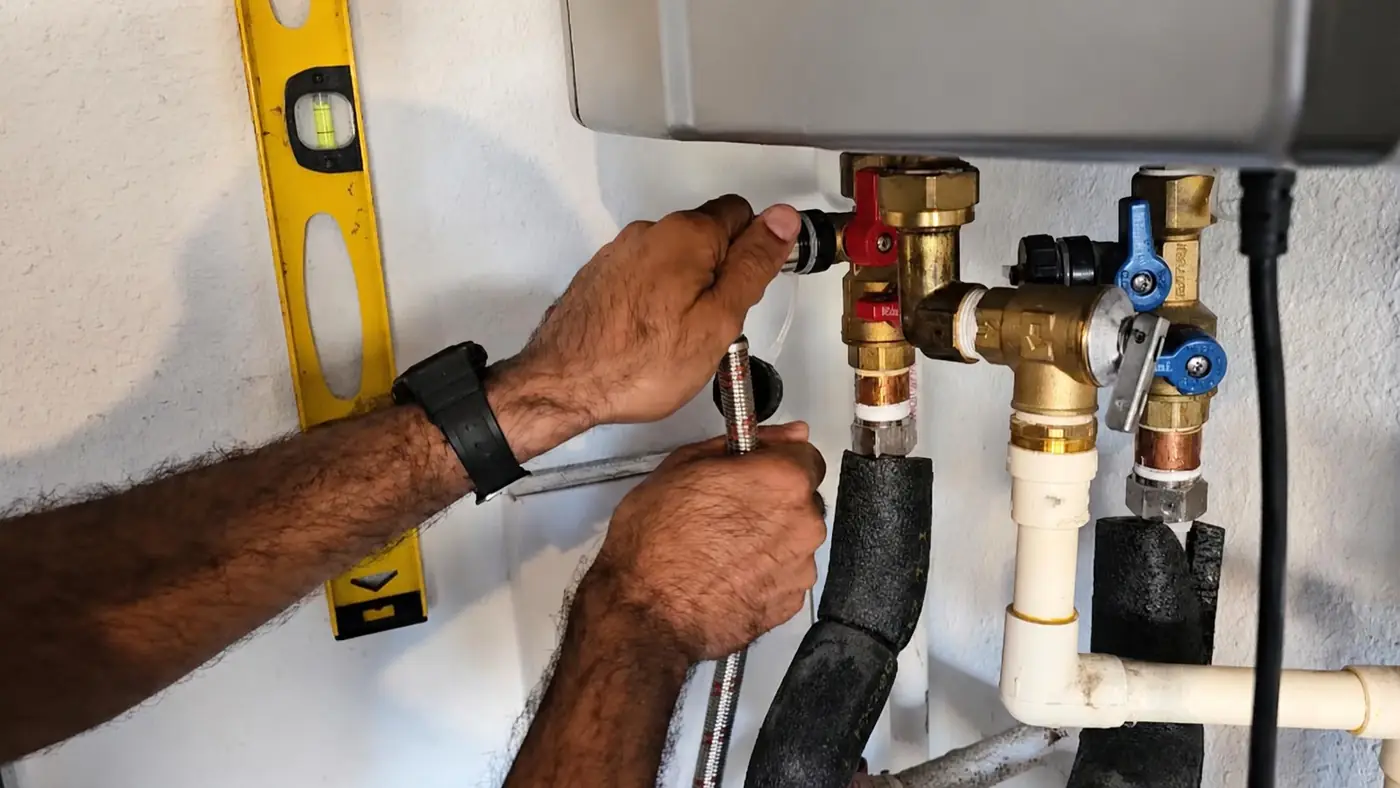
Install with service valves
Isolation valves on the unit make future flushing easy.
- 4
Set and test
We set the temperature, check flow and show you the controls.
Gas or electric tankless
Gas tankless
- Heats a high flow, suited to whole homes
- Needs a properly sized gas line
- Needs approved venting and combustion air
- Safety first: gas smell means leave and call 911
Electric tankless
- No venting needed
- Needs a high-amp circuit and sometimes a service upgrade
- Often used for point of use
- Limits on flow in cold incoming water
Thinking about tankless?
Call and tell us about your home and your current heater. We will plan a visit.
Signs your tankless needs service
- An error code on the display
- Hot water that cuts in and out
- Reduced flow or lukewarm water
- Rumbling or ticking noises, often from scale
- Water leaking at the unit or its valves
What affects the price
Sizing a tankless heater for your household
A tankless unit is rated by how much hot water it can deliver at once, and that depends on the temperature rise you need. Water arrives cold, and the unit must lift it to your setting. A shower and a dishwasher running together draw more than a single shower.
We add up the fixtures you might run at the same time and choose a unit that covers that load. Buying too small leads to lukewarm water in busy hours, and too large adds cost without a benefit.
Common error codes and what they point to
Each brand has its own codes, but the causes are similar: a clogged inlet filter, a blocked vent, a gas supply issue, a scale-restricted heat exchanger or a sensor fault. Writing down the code and the model number helps us diagnose by phone before we arrive.
Do not keep resetting a unit that keeps faulting. Repeated resets can hide a safety problem.
Descaling in soft-water Bothell
The City of Bothell says its drinking water is soft. That helps tankless heaters, since scale builds slowly. A flush is still part of normal care, because even soft water carries some minerals.
Ask us how often your model should be flushed. For a standard tank unit, see water heater installation. If a tank has failed, water heater replacement covers that.
Tankless gas and venting work follows the Uniform Plumbing Code (UPC) as adopted in WAC 51-56 and the unit manufacturer instructions.
Tankless water heater questions
Tankless service is usually scheduled, and same-day appointments are available when we have openings. If you have no hot water, call (425) 845-0257 and we will help you triage. A gas smell means leave and call 911.
Once a year is a common recommendation. Check your manual. Hard-water areas need it more often. Bothell water is soft, but we still recommend periodic service.
Often yes. Tankless units draw much more gas at once than a tank. We measure the line before you buy.
They often have a longer expected life than tanks, if maintained. We help you plan service.
This can be low flow, a clogged inlet filter or a scale buildup. A visit usually finds the cause.
A leak should be fixed promptly. It may be a fitting or the heat exchanger. We check which.