
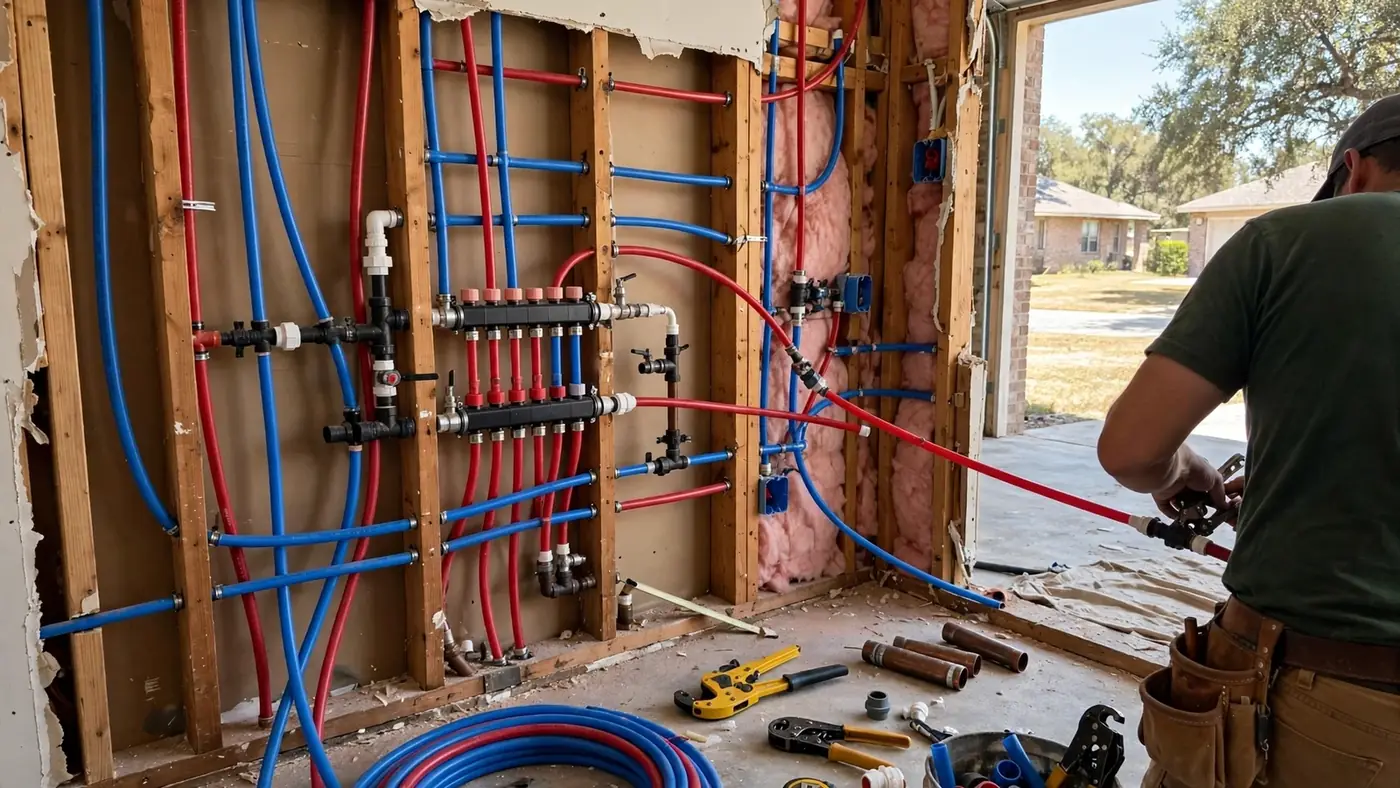
Why repiping is a planned project, not an emergency
Repiping replaces the water supply lines in your home. Done well, it ends a cycle of repairs on pipe that is wearing out everywhere at once. It is a planned job, so we focus on a clear scope, a clear price and as little disruption as possible.
If you have a leak right now, burst pipe repair is the right page. This one is for people who have had more than one leak, or who want to fix a known problem pipe before it fails.
Signs a repipe may be the right answer
Repeated pinhole leaks
Several small leaks in copper, especially in different rooms, suggest the whole line is thinning.
Brown or rusty water
Galvanized steel corrodes from the inside and can discolor the water.
Low pressure at many fixtures
Buildup inside old pipe narrows the opening.
Known problem pipe
Polybutylene, a gray plastic used in some homes decades ago, is prone to failure.
Pipe materials compared
We explain which fits your home. This is the short version.
| Material | Strengths | Things to consider |
|---|---|---|
| Copper | Long track record, rigid, heat tolerant | Higher material cost and more labor |
| PEX | Flexible, fewer joints, quicker to install | Not for exposed sunlight, needs proper support |
| Galvanized steel | Used in older homes | Corrodes inside, usually replaced rather than repaired |
| Polybutylene | Used in some 1970s to 1990s homes | Known to fail, usually replaced |
Planning a repipe?
Call and tell us what you have noticed. We will schedule a visit and walk the house.
How a repipe project runs
- 1
Walk the house
We look at every fixture, the main shutoff and where the pipes run.
- 2
Write the scope and price
You get a clear price before work starts, with a plain description of what is included.
- 3
Plan access
We choose routes that limit wall and ceiling openings and protect your floors.
- 4
Install and test
New lines go in, we pressure test the system and restore water.
What affects the price of a repipe
Living through a repipe
A repipe is disruptive for a few days, but it is manageable with planning. Water is off for part of each day. We protect floors, open walls only where needed and leave the house usable at the end of each day when possible.
Plan for access to every room with a fixture, and move furniture and valuables away from walls we will open. Tell us about pets and children so we can plan the work safely.
Getting ready for a repipe
- Walk through with us and note every fixture
- Clear closets and walls where we will work
- Choose a patching plan for drywall
- Arrange for water, a bathroom and meals during the work
- Confirm the permit and inspection dates
- Keep the invoice and permit copy for your records
Older Bothell homes and their pipes
Bothell grew quickly after 1950, and many neighborhoods have houses from the decades that followed. Homes from that period can have galvanized steel, copper or polybutylene supply lines depending on the year and the builder.
Bothell water is described by the City as soft, and the City reports that lead comes mainly from service lines and home plumbing. If your house still has older lines, ask us to identify the material. See water service line repair if the line from the meter is also in question.
Repiping is done to the Uniform Plumbing Code (UPC) as adopted in Washington under WAC 51-56, which sets approved materials, support spacing and testing.
Repiping questions
Repiping is planned work, and we schedule visits, including same-day when openings allow. If you have a leak right now, call (425) 845-0257 any hour and we will handle that first.
It depends on the size of the house and access. A small home can be done in a few days. We will give a schedule with the price.
During the work, yes, for portions of each day. We plan around it and restore water at the end of each work day when possible.
Repiping typically does. We confirm with the Bothell Permit Center and tell you what applies.
Both are accepted in Washington under the plumbing code. PEX is faster and flexible. Copper is rigid and long established. We explain the trade-offs for your house.
Yes. If only one run is failing, a partial repipe may be enough. We advise on that during the visit.