
What to do the moment you see water
These steps protect your floor and the unit.
- 1
Close the water valves
Use the isolation valves on the cold and hot lines to the unit, or the main valve if they are stuck.
- 2
Turn off power or gas
Switch off the electric supply. For gas units, close the gas shutoff. If you smell gas, leave the house and call 911.
- 3
Dry and look
Wipe the area and watch where the water reappears. Take a photo for later.
- 4
Call if you cannot find it
A tankless leak inside the cabinet needs a technician.
The usual suspects
The most common leak is at a fitting. Connections at the isolation valves, the water pipes and the pressure relief line can loosen with vibration and heat cycles. These are usually a quick repair.
The second most common source is the condensate line on condensing units. If the drain is blocked, water backs up and leaks. It is a simple fix when caught early. A leak from the heat exchanger or inside the cabinet is more serious, and the unit may need repair or replacement.
Where tankless leaks come from
| Source | What it looks like | Usual outcome |
|---|---|---|
| Loose fitting | Drip at a pipe connection | Tighten or replace a washer |
| Isolation valve | Drip at the valve stem | Replace the valve |
| Relief valve | Water at the discharge line | Check pressure, replace the valve |
| Condensate line | Water at the drain connection | Clear and test the drain |
| Heat exchanger | Water inside the cabinet | Repair or replace the unit |
Tankless unit leaking?
Call and tell us what you see and whether the unit is gas or electric. We will help you triage.
Descaling and why it matters
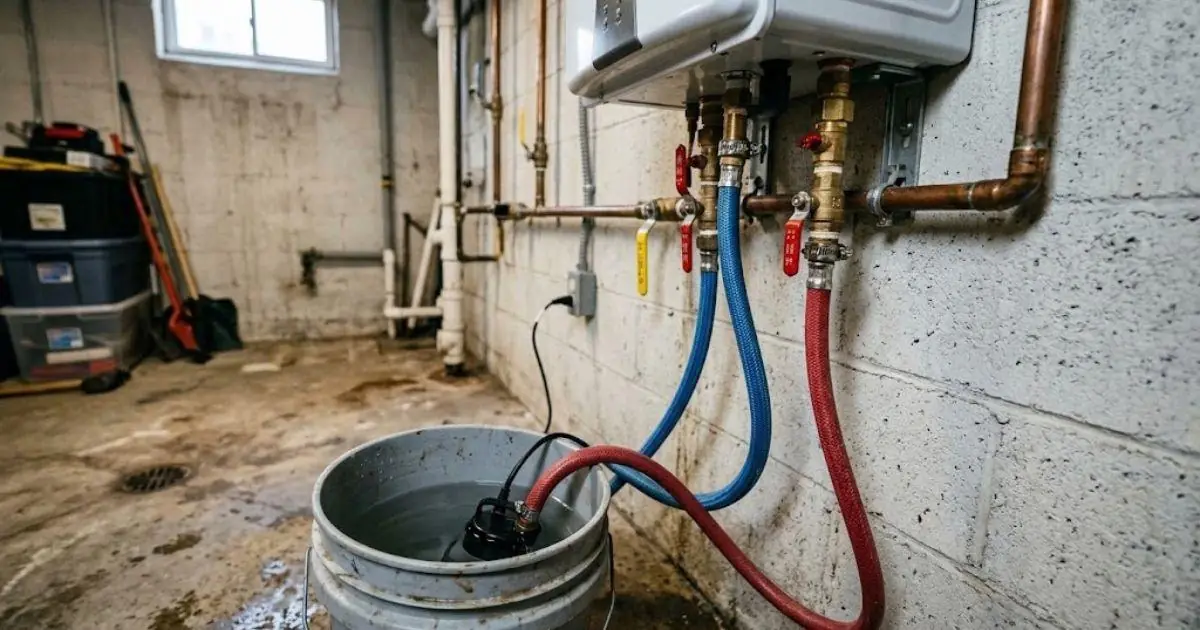
Mineral scale builds up inside the heat exchanger and can cause overheating, noise and eventually leaks. A descaling flush with a pump and a mild acid solution removes the buildup. Most manufacturers recommend periodic flushing.
Bothell water is soft, according to the City, so scale builds slowly. A flush is still a good idea. Ask us how often your model needs it, and see tankless water heater for how we handle flushes and repairs.
Repair or replace
A leak at a fitting or a valve is a repair. A cracked heat exchanger often costs close to a new unit. If the unit is older and the repair is major, replacing it may make more sense.
We tell you the options after we find the source. If the unit is beyond repair, our water heater installation page explains what a new unit involves.
What a leak can damage before you notice
A tankless unit hangs on a wall, often above finished surfaces. A slow drip can run down drywall, soak insulation or rot a garage wall plate before it shows. Look at the wall below the unit and at the floor for stains, swelling or a musty smell.
A leak can also trip the unit into an error code or cause the circuit board to fail if water reaches it. If the control panel acts strangely after a leak, leave the unit off and have it checked.
Preventing the next leak
Flush the unit on schedule, keep the inlet filter clean and check the isolation valves for slow weeps. Make sure the condensate drain flows. Insulate exposed outdoor or garage lines before a cold snap. Test the relief valve if the manual calls for it.
A yearly look by a technician catches loose fittings and early scale before they become leaks.
What to tell the technician
- Model and age of the unit
- Gas or electric
- Where the water appeared and when you first saw it
- Any error codes on the display
- Whether the unit has been flushed and when
- Whether the water is still shut off
Tankless leaks and Bothell homes
In Bothell, tankless units often sit in a garage or on an exterior wall. Garage and outdoor units face temperature swings, and a cold snap can freeze a condensate line or an exposed fitting. Check that exterior lines are insulated.
If the unit sits in a closet or crawl space, a slow leak can run unseen for weeks, so check the area around it from time to time. We serve Kenmore and nearby towns listed on our service areas page. If a gas smell ever accompanies a leak, leave and call 911.
Tankless leak questions
It is urgent. Shut off the water and power or gas, and call. A small drip at a fitting is less serious than water pouring from the cabinet, but both should be looked at soon.
Yes, in a cold snap. Exposed lines and condensate drains on garage or exterior units can freeze and crack. Insulate exposed pipes and know where the shutoff is.
Water inside the unit, error codes and rumbling are signs. A technician can confirm with a pressure test.
Repairs to a leak are generally exempt in Bothell code, but exemptions do not authorize code violations. Replacement needs a permit. Ask us what applies.
It may be high pressure or high temperature. Do not cap it. Call us to check.
Follow the manual. Once a year is common. Soft water extends the interval but does not remove the need.