
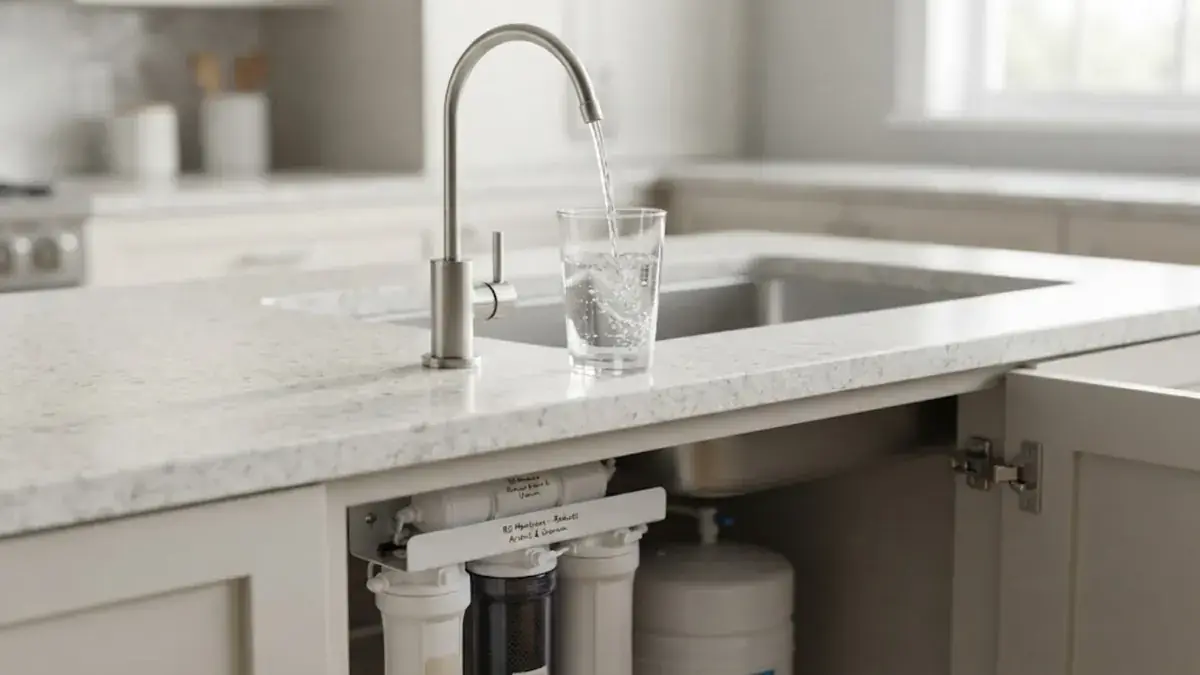
What the system includes
Most under-sink RO kits include a sediment filter, a carbon filter, the membrane, a storage tank, a dedicated faucet and the tubing and fittings to connect them. The feed line taps into the cold water supply, usually at the angle stop under the sink.
Water pushed through the membrane is cleaned. Water that does not pass carries the rejected contaminants away, and that flow goes to the drain. That is why RO needs a drain connection, not just a supply.
How the plumbing goes together
- 1
Tap the cold supply
A feed adapter on the cold angle stop sends water to the system. Shut off the stop first.
- 2
Mount the unit and tank
Position the filter housings and tank under the sink with room for filter changes.
- 3
Add the faucet
The RO faucet needs a hole in the sink or countertop, sometimes a spare sprayer hole.
- 4
Connect the drain
A saddle clamp on the drain line above the trap takes the reject water. Some setups use an air gap faucet.
- 5
Flush and test
Fill the tank, flush the filters and check every connection for drips.
Parts and where leaks start
| Part | Job | Where it leaks |
|---|---|---|
| Feed adapter | Taps the cold supply | Loose compression nut |
| Tubing and push fittings | Carry water between parts | Poorly cut or seated tubing |
| Filter housings | Hold the cartridges | O-ring not seated |
| Drain saddle | Sends reject water to the drain | Poor seal or bad hole |
| Tank valve | Isolates the tank | Loose fitting |
Want it installed?
Call and tell us what system you have. We can connect it and check for leaks.
Common mistakes
The most common mistake is tubing that is not cut square or pushed all the way into the fitting. It may hold for a day and leak a week later. Another is drilling the drain saddle onto a pipe below the trap, which lets sewer gas through.
Placing the unit too tight is another issue. Filters and the membrane need replacing on a schedule, and you need room to open the housings. Plan access before you mount the unit.
Is RO the right choice for your water
RO is one option among several. Whether you need it depends on what is in your water and what you want out of it. A basic carbon filter handles taste and odor. RO also reduces dissolved solids and some contaminants.
Check the water quality report from your utility. It lists what is in the water at the plant. It does not show what is in your pipes, which is why older homes with older lines sometimes consider filtration. Ask us if you are not sure.
Where the system fits under the sink
Many kitchens have a disposal, a dishwasher line and cleaning supplies under the sink, which leaves little room. Measure the cabinet before you buy. The filter housings need space below them to unscrew for filter changes, and the tank can sit in a side cabinet or the basement with a longer tube.
A cramped install tends to kink tubing, which restricts flow and can cause leaks. If the space is tight, ask about a compact unit or a remote tank.
Maintenance that keeps it working
Replace the sediment and carbon filters on the schedule in the manual and the membrane less often. Sanitize the system when you change filters if the maker advises it. Keep a note of the dates under the sink.
If the water starts to taste off or the flow slows to a trickle, the filters are probably overdue. A pressure gauge on the tank helps diagnose a failing tank bladder.
Leak check after the install
- Dry every fitting with a paper towel and check again after an hour
- Check again the next morning
- Look at the drain saddle for seepage
- Check the faucet base under the sink
- Watch the tank connection for drips
- Check once a week for the first month
Water quality and RO in Bothell
The City of Bothell says its drinking water is soft and comes from Seattle Public Utilities, from the Tolt and Cedar watersheds. The City water quality report lists lead and copper results well below the action levels. It also says lead comes mainly from service lines and home plumbing, and suggests flushing the tap after the water has sat for a while.
If you are on one of the four water districts in Bothell, check that district for its report. RO is a personal choice, not a requirement. If your supply lines are old, see repiping. For work under the sink, see faucet repair. We serve Kenmore and nearby towns on our service areas page.
The drain line from a reverse osmosis unit should connect through an air gap, a Uniform Plumbing Code (UPC) requirement that Washington adopts in WAC 51-56.
Reverse osmosis questions
Not for safety reasons by itself. The City reports soft water from Seattle Public Utilities with lead and copper results below the action level. Some people choose RO for taste or to reduce dissolved solids. It is your call.
The saddle clamps onto the drain line above the trap, usually on the sink tailpipe. We cut a clean hole and check the seal.
Follow the manufacturer schedule. Sediment and carbon filters are changed more often than the membrane.
Yes. It sends some water to the drain as reject water. The ratio varies by system, so check the specifications of the one you choose.
Many people do. If you are not comfortable cutting into a drain line or fitting valves, hire a plumber. A leak under a sink is a cabinet problem.
It may be a worn cartridge or a loose connection. Close the tank valve and check the fittings.